
What New Powered Medical Carts Really Mean For Hospital IT
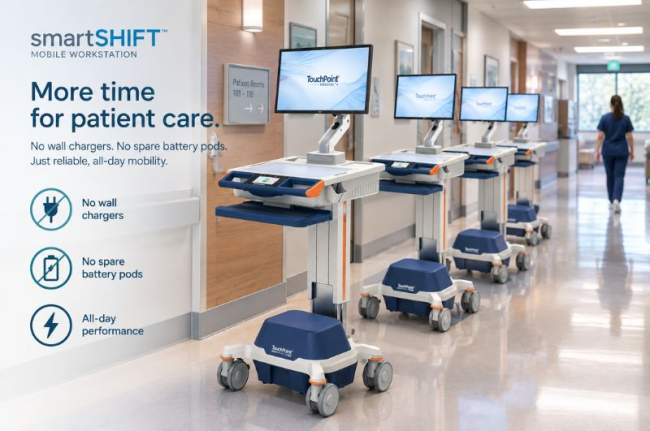
Every hospital nurse wants the best computer on wheels. But for healthcare IT departments, deploying a workstation on wheels (WOW) isn't a single-cart issue. In fact, selecting a model represents a long-term infrastructure commitment. Less carefully vetted WOW fleets can yield hidden costs that multiply over time, depleting capital budgets, impacting maintenance schedules, and driving up IT labor costs. Therefore, when evaluating a hospital computer on wheels, CIOs and IT directors must anticipate the total demand that model will place on their team over its lifetime.
Legacy WOW brands traditionally build their systems around swappable battery pods and wall chargers. This approach forces technology departments to buy and maintain a costly shadow fleet of spare parts. Beyond the physical footprint required, every charging dock and extra battery adds a serialized component that hospital IT staff must track, maintain, and eventually replace.
In the modern hospital, IT leaders must rethink how mobile hardware impacts enterprise operations on a macro level. And that means moving away from reactive fleet maintenance. Proactive strategies ensure that infrastructure serves the clinical staff rather than burdening the technical support teams.
The global computer on wheels market is evolving toward self-contained, high-performance power architectures. Modern hospitals demand solutions that survive full usage cycles without requiring external docks or redundant safety nets. Advanced carts like smartSHIFT™ achieve this feat of engineering using a 1000W AC inverter paired with LiFePO₄ battery chemistry rated for over 3,000 lifecycles.
Heavy-duty power architectures like these eliminate the entire secondary-battery ecosystem altogether. Maintaining continuous power without external infrastructure immediately reduces IT workloads. In general, staff no longer has to waste hours walking the halls tracking down missing parts. That allows IT professionals to dedicate their time to critical digital projects and network upgrades—the kind of capital improvement projects administrators are always pressing for.
Historical strategies in computer on wheels healthcare deployments dictate replacing fleets every few years. Failing power cells frequently force these expensive upgrades long before the cart frame actually breaks. This disjointed lifecycle traps hospitals in a perpetual state of costly hardware churn.
Unfortunately, the industry standard often covers the chassis while leaving the battery unprotected or on a disconnected timeline. This critical coverage gap leaves IT departments on the hook for unpredictable replacement costs throughout the asset's lifespan. An unexpected battery refresh for a 500-cart fleet can instantly derail an annual IT budget.
A comprehensive warranty covering both the frame and the battery for the full equipment lifecycle fundamentally changes the financial equation. It wipes out those hidden maintenance budgets completely. IT leaders can finally forecast their long-term capital expenditures with absolute precision, protecting funds for vital cybersecurity initiatives instead of emergency hardware repairs.
smartSHIFT™ comes standard with a comprehensive, industry-leading five-year warranty. Seven- and ten-year warranties are also available for CIOs who prefer the peace of mind of long-term fleet coverage, or need alignment with capital planning cycles. This flexible coverage model ensures the technology investment remains protected well into the future.
Fleet management is rapidly shifting from physical maintenance to centralized, digital oversight. Managing a modern powered medical cart fleet means preparing to connect the hardware directly to the operational frameworks CIOs already run. While Day 1 value relies on eliminating physical redundancies, the near-term roadmap for smartSHIFT™ focuses entirely on this connected intelligence.
Future integrations with platforms like ServiceNow will eventually automate ticketing and streamline helpdesk workflows directly from the cart. Furthermore, planned active RTLS (Real-Time Location System) tracking will provide enterprise-wide asset visibility. Seeing exactly where every unit sits on a centralized digital dashboard will simplify preventive maintenance and make inventory audits seamless. Instead of dispatching helpdesk staff to search a multi-floor labyrinth for one problematic cart, technicians will pinpoint its exact location instantly.
Ultimately, smarter tracking will turn a chaotic physical fleet into a highly organized, easily manageable digital asset. Positioning your hospital for this digital layer starts with securing the right physical hardware today. The core smartSHIFT™ platform establishes the robust power and structural foundation necessary to support these upcoming enterprise integrations.
As mentioned, unvetted powered cart fleets can multiply hidden costs at every turn. Secondary backup carts, spare battery inventories, charging infrastructure, frequent replacement cycles, and disconnected warranty timelines all eat into already-squeezed margins. Eliminating these inefficiencies represents the most immediate financial benefit of upgrading your mobile hardware.
Stripping away those hardware redundancies allows hospitals to achieve up to a 75% reduction in Total Cost of Ownership, or TCO. The underlying logic is straightforward: One cart supporting two full shifts with zero battery swapping translates to fewer capital assets on the floor. Consolidating the hardware footprint instantly reduces the volume of serialized components IT must track.
That means fewer replacement events. It also reclaims valuable square footage previously wasted on battery charging rooms. Adopting a smarter infrastructure guarantees significantly lower long-term spend while keeping your clinicians charting without interruption.
Before authorizing your next fleet refresh, consider evaluating vendors based on their total infrastructure footprint. Assessing the true operational impact requires looking far beyond the initial purchase price. Ask your vendor the following critical questions to protect your capital budget:
- Does this system require a secondary infrastructure of wall chargers and spare batteries to function continuously?
- Does the comprehensive warranty cover the battery for the full lifecycle of the cart, or are the timelines disconnected?
- What is the realistic IT workload required to manage and maintain this fleet's serialized components at scale?
- How much of the fleet servicing and maintenance workload can you take off of our department's plate?
Contact your TouchPoint Medical representative today to request a custom fleet optimization model and explore how smartSHIFT™ can streamline your IT operations, guaranteed up to a full decade.
Sources & Citations
- RELiON Battery. (n.d.). Lithium Iron Phosphate (LiFePO4) vs Lithium Ion Batteries. Retrieved from https://www.relionbattery.com/blog/lithium-iron-phosphate-lifepo4-vs-lithium-ion-batteries
- TouchPoint Medical. (2026). smartSHIFT TCO Calculator & Fleet Optimizer. Retrieved from https://www.touchpointmedical.com/
