
Product Spotlight: workFLO® Non-Powered Workstation on Wheels
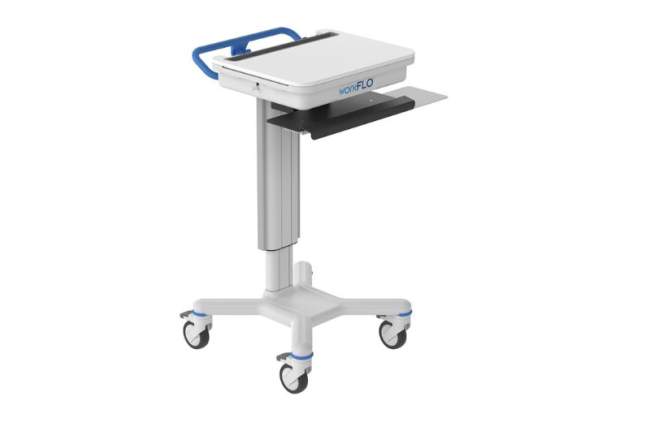
In today’s fast-paced healthcare environment, mobility and adaptability of point-of-care tools make a real difference in workflow efficiency and patient experience. That’s why the new workFLO® Non-Powered Workstation on Wheels from TouchPoint Medical stands out as a smart solution for teams that need to move, adapt, and respond without the constraints of powered workstations.
Streamlined, lightweight design — The workstation is crafted for maneuverability and simplicity: it delivers a sleek footprint that fits in patient rooms, ambulatory areas and other clinical settings.
Height-adjustable work surface — A gas-spring assisted lift mechanism enables easy adjustment of the work surface to match a caregiver’s height or preferred posture.
Antimicrobial surfaces & cleaner design — Surfaces are engineered to resist bacterial proliferation, supporting infection control efforts in high-traffic clinical environs.
Secure equipment mount & locking tech bay — The workstation supports a monitor, all-in-one computer or mini/micro PC, with a key-locked tech bay for equipment security.
Stable, mobile base — With a stable wheelbase design and locking casters, it’s built to safely roll through corridors and lock in place at the bedside.
Accessory integration & flexible configuration — A wide range of accessories such as drawers, baskets, printer trays, scanner holders and more let you tailor the cart to the specific workflow or department.
With increasing demands on healthcare staff — from documentation and monitoring to patient rounding and coordination — the ability to bring computing and documentation tools directly to the point of care is critical. Because this workstation is non-powered, there are fewer constraints around charging, battery maintenance or power cabling, which tends to simplify deployment in busy units.
Moreover, the ergonomic adjustability helps caregivers reduce strain, especially when switching between seated documentation and standing interactions. The antimicrobial work surface and compact footprint also align with infection prevention and spatial optimization efforts in modern facilities.
Bedside charting and documentation in patient rooms or ICU settings.
Rounding carts for mobile clinicians who need ready access to computing and documentation tools throughout the unit.
Ambulatory surgery centers, long-term acute care units or any environment where flexibility and mobility trump permanent installations.
Deployments where power availability is limited or where a “plug-and-go” solution is preferred over battery-managed carts.

Configure with the right accessories — Start by identifying the critical items your staff carry (scanner, printer, supplies) and add the proper drawers or trays for optimal one-stop functionality.
Standardize heights across users — Choose a default height range that accommodates your predominant user group, and train staff on quick adjustment to personalize for each use.
Lock casters when stationary — While mobility is key, locking casters during charting or documentation stabilizes the workstation and improves ergonomics.
Maintain hygiene routines — Leverage the antimicrobial surface by including it in your standard wipe-down protocols; clean surfaces consistently to sustain the advantage.
Plan for storage and nesting — When not in active use, the compact footprint and nesting feature (multiple units stored closely) help reclaim space.
The workFLO® Non-Powered Workstation on Wheels delivers a thoughtful balance of mobility, functionality and clinical-friendly design. For healthcare facilities seeking a reliable, adaptable workstation without the complexity of powered carts, this is a compelling choice. Whether for documentation, rounding, or mobile care delivery, it helps bring the computing power to where care happens — not the other way around.
